6 CEE Faculty Recognized for Excellence in the Classroom
Georgia Tech students have weighed in and six professors from the School of Civil and Environmental Engineering have been honored for their exceptional classroom skills.
Dr. Ryan J. Sherman is an Associate Professor in the School of Civil and Environmental Engineering at the Georgia Institute of Technology, where he joined the faculty in 2019. He specializes in steel structures, fatigue and fracture, large‑scale structural experimentation, field monitoring, metallic additive manufacturing, welded-joint performance, and structural system redundancy. His work integrates laboratory testing, analytical simulation, and in‑service monitoring to explore the behavior and performance of metallic structures and enhance the function, resilience, and safety of past, present, and future civil infrastructure. Dr. Sherman earned his B.S. in Civil Engineering from Michigan Technological University (2007) and his M.S. and Ph.D. in Civil Engineering from Purdue University (2009, 2016). His professional background includes serving on the faculty at the University of Nevada – Las Vegas and working as a Research Engineer at Purdue University’s Bowen Laboratory. Dr. Sherman is a registered professional engineer in the state of Nevada.
Dr. Sherman’s research focuses on understanding and advancing the behavior and performance of steel bridges, buildings, and ancillary highway structures. His work spans fatigue and fracture behavior, large‑scale structural testing, field monitoring, material characterization, and finite element simulation. He has led and contributed to major research initiatives for NCHRP, FHWA, multiple state DOTs, and industry partners, with outcomes that have directly informed and improved AASHTO design and evaluation specifications. Dr. Sherman has conducted numerous full‑scale laboratory experiments and field monitoring campaigns across the United States, providing transportation agencies with critical data to guide maintenance, repairs, and retrofit decisions, as well as to refine design methodologies. In addition, he is a national leader in large‑format metal additive manufacturing for structural applications, directing research programs and serving on technical committees that are advancing metallic AM toward safe and practical in‑service deployment.
Ph.D. in Civil Engineering Purdue University 2016
M.S. in Civil Engineering Purdue University 2009
B.S. in Civil Engineering Michigan Technological University 2007
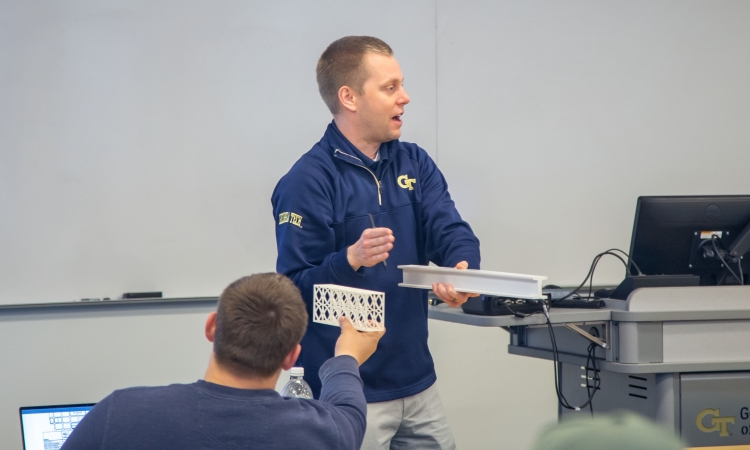
Dr. Sherman’s teaching interests include the behavior and performance of steel bridges, buildings, and ancillary highway structures. His Georgia Tech teaching portfolio comprises a variety of undergraduate and graduate courses, including Statics, Mechanics of Deformable Bodies, Introduction to Structural Engineering, and Behavior of Metal Structures. Dr. Sherman actively seeks opportunities to enhance his instruction, with past activities including the ASCE Excellence in Civil Engineering Education (ExCEEd) Program, the AISC Educator Workshop, and the Georgia Tech Class of 1969 Teaching Fellows Program. Dr. Sherman has improved student success from these programs by developing hands-on demonstrations, creating group activities, and integrating projects to enhance student communication skills.
Georgia Tech students have weighed in and six professors from the School of Civil and Environmental Engineering have been honored for their exceptional classroom skills.
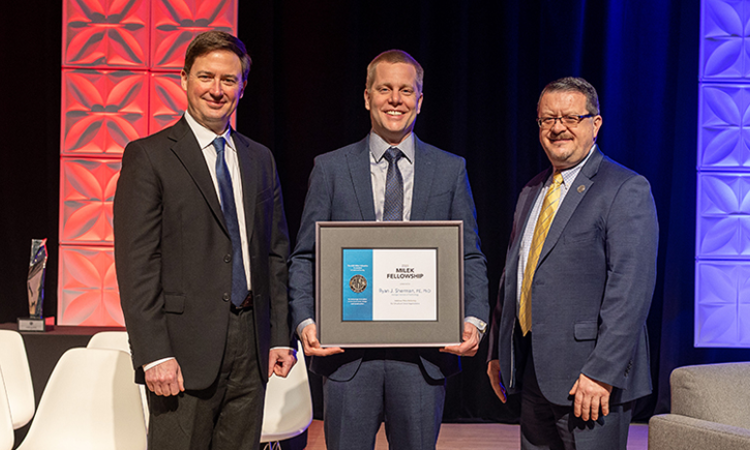
Assistant Professor Ryan Sherman has been awarded the American Institute of Steel Construction’s (AISC) 2023 Milek Fellowship in recognition of his innovative research on metallic additive manufacturing. Since 2004, AISC has given a promising non-tenured university faculty member the four-year, $200,000 award.
The Steel Bridge Task Force, which consists of the American Iron and Steel Institute, the National Steel Bridge Alliance, and the American Association of State and Highway Transportation Officials T-14 Technical Committee for Structural Steel Design, have selected assistant professor Ryan Sherman as the recipient of the 2023 Robert J. Dexter Memorial Award Lecture.